Showing posts with label Reviews. Show all posts

Thursday, January 20, 2011

KCACTF Review 2: The Odyssey

In modern times, it wouldn’t be surprising to hear many people answer the question “What is the Odyssey?” with the retort “a mini van.” However, the theatrical production of The Odyssey, performed by Minnesota State University Mankato, brings a contemporary element to the epic story, making it another modern Odyssey worth recognizing.
            The Odyssey is one of two Greek epic poems by Homer. This particular poem centers on Odysseus, a cunning Greek hero who spends ten years trying to return to his homeland of Ithaca after fighting for a decade in the Trojan War.
            While Odysseus combats Cyclops, resists the sweet songs of the Sirens and is kept captive by the goddess Calypso, his wife Penelope and son Telemachus must ward off the suitors who come to woo the assumed widow. With the help of the goddess Athena, Odysseus attempts to return to his wife, unknowingly racing against time and the attentions of other men.
            The version performed by Minnesota State University Mankato is a humorous and irreverent adaptation of the direction by Mary Zimmerman, which often makes fun of the original Odyssey within the confines of the plot. While the entirety of the poetic Odyssey could take days to perform, Zimmerman’s abridged three-hour version moves at a steady pace and contains enough witty dialogue to keep audiences engaged.
            With 29 actors in the cast, there is hardly ever a dull moment. Clayton Oliver Rutschow, who plays Odysseus, tackles the role with a domineering stage presence. Rutschow fully grasps the many facets of Odysseus’ complex personality, from his compulsive lying to his determination to fight all odds against him, making his performance believable and inspiring.
            Also exceptional was Kimberly Michelle Steffen as Athena, Odysseus’ guardian angel (or God) and narrator of the play. Steffen enthusiastically took on Athena’s mortal disguises, ranging from a precocious child to an old man. The on-stage costume changes made Athena’s guises easy to follow, but her commitment and seriousness in playing each new role brought many laughs to the eager audience.
            In tackling a play of epic proportions, director Paul Hustoles chose an adaptation of the script that suited both his cast and the audience. While mentions of the Odyssey might cause some people to groan while remembering sleeping through the poem in high school English class, Hustoles’ creative stage directions make it impossible for audiences to fall asleep.
With a large ensemble, Hustoles employs actors to portray animals, posing as everything from sheep to dogs to pigs. The ensemble’s bestial mannerisms and “baas” and “oinks” are not only natural, but are hilarious as well, as audiences are pleased to see “animals” roam in and out of the scenes.
The set designed by Tom Bilese consists primarily of white sheets attached to long wooden poles, which are transformed from ship sails to Grecian pillars within seconds. Additionally, the blank backgrounds of the sheets allow for shadowing effects, which were especially effective in the memorable Cyclops scene, where the one eyed giant appeared to “eat” an actor.
To help establish the setting in the numerous scene changes, Steven Smith’s light cues effectively provide warm, golden glows when the action shifts to the heavens, and icy blue hues when Odysseus travels to the underworld. Masks worn by the gods and traditional Grecian togas worn by commoners also help to distinguish between characters, as many actors take on multiple roles throughout the show.
The drama’s only weakness lies in the sound, which incorporates both pre-recorded effects and melodies. Though not used often, the voice-overs came through as fuzzy and unclear, and the songs in the background and during scene changes seemed out of place.
Overall, the show was an incredible success, vividly depicting the long adventure of Odysseus with a tongue-in-cheek approach that leaves audiences simultaneously laughing at and cheering on the ancient Greek hero. 

Wednesday, January 19, 2011

Kennedy Center American College Theater Festival Review 1: Oedipus Rex

Don’t gouge your eyes out – St. Ambrose University’s performance of Oedipus Rex requires attentive eyesight to appreciate the doomed Oedipus’s attempt to avoid his prophesized fate. This unique, devised theater production utilizes ensemble collaboration in everything from physical movement to dramatic spotlights. Additionally, each of the seven cast members move seamlessly into multiple roles, both conceptual and human, to brilliantly convey the universality in Oedipus’s tale in a show that viewers must see to believe.

Saturday, November 27, 2010

(Much closer to Broadway): Billy Elliot ‘shines’ as dancing show

Eleven year olds fill an awkward space in adolescence. Often entering the perplexing “pre-teen” stage, they express themselves with random outbursts of energy, attitude and sadness.
Billy Elliot, the main character of the musical with the same name, is eleven years old, but in many ways, the musical itself seems like an eleven year old – energetic, occasionally awkward and charming all at once.
Set in Northern England in 1984, the plot centers on those affected by the yearlong British National Union of Mineworkers strike.  While the town’s adults outwardly struggle to maintain strength in the face of unemployment, Billy struggles internally with a secret dream to pursue a career as a ballet dancer.
Due to the fact that male “ballerinos” aren’t exactly respected in modern times, it’s clear that they didn’t have a place in the mining towns of England – especially when “real” men were those who took boxing lessons. Billy’s father (Rich Hebert) and brother (Jeff Kready) do not support the visions that dance in Billy’s head. The boy is then left with only the assistance of his dance teacher Mrs. Wilkinson (Faith Prince) to find a way to pursue his dreams.
Shown with the other "Billys" Lex Ishimoto, center,
played Billy Tuesday, Nov. 23.
The touring production, now showing at the State Theater, travels with 20 children. Five of them are “Billys”, though Lex Ishimoto, a 12-year-old hip-hop dancer from California, played Billy for the Tuesday performance. Much like his character, Ishimoto’s dancing makes him a prodigy. As a trained dancer myself, I saw not one misstep, no matter how hard I looked. His pirouettes were perfect, his fouettes flawless.
Instead, Ishimoto’s fault lies in his singing, which was almost always off-key. Sounding like an even younger version of Justin Bieber (if that’s possible), Ishimoto’s unchanged voice was often harsh on the ears. However, much like with Bieber, audiences will readily forgive the annoying singing because of the appearance (in this case, of the beautiful dancing) of the source of the sound.
Much of the stage time belongs to Billy, but the other children in the cast often steal the show. Billy’s young friend Michael (Jacob Zelonky) is adorable as a boy who enjoys dressing up in his sister’s clothes. Given that Zelonky is only 11 himself, he handles the role of a young, gay boy with great maturity.
The inclusion of Billy’s cross-dressing friend is just one instance of the show’s exploration of societal themes. For 11-year-old Jacob, cross-dressing is perfectly acceptable because it brings him happiness. When justified by Jacob, one can’t help but wonder why any member of society feels entitled to dictate the behavior of others when happiness is at stake. The children in the show have it right – if it makes someone else happy, don’t question it.
Also memorable are the “ballet girls” in Billy’s dance class. Though they travel in a pack, each individual dancer (ranging from 11-18 years in age) has a distinct personality. Also, though they dance poorly, each ballerina is expertly trained and is instructed to forgo her classical technique in order to emphasize Billy’s greatness. Because many of the actresses are so young, they resemble the typical competition dance “infants” that have smiles plastered on their faces the whole number instead of reacting to the lyrics of the song.
For a touring production, the special effects and scenery are quite remarkable. From a dance studio inside of a gym to a dressing room with personified dancing dresses, the set is completely reminiscent of the Broadway production. None of the scenery feels compromised, giving audiences nationwide the full effect of the original show.
Amazingly, cast members young and old speak as though they were born and raised in Northern England. The accents used in the show are completely authentic and believable. Though the cast members sound as though they hail from Ireland, residents of Durham County speak with a pitimac accent. Now less frequently heard, pitimac accents are characteristic of those in Northern England who spent much time in the mines.
Besides speaking well, the adults in the show successfully unite the cast and emphasize the suffering the community undergoes together. Because the town is so united, Billy is even more outcast from his family, which makes the story more relatable and inspiring.
The show revolves around dancing. As a result, the musical’s songs, though written by Sir Elton John, are not memorable. The phenomenal dance moves are ultimately more gossip-worthy, as opposed to the tunes sung by “Billy Bieber” and his fellow cast mates. Though Billy Elliot did win the Tony Award for Best Musical in 2009, it is more of a dance show than anything else.  
Above all else, Billy Elliot encourages audience members to realize that ultimately, a child needs the support of his or her family to succeed. However, the writers of the script readily acknowledge that sometimes, children know best. It was Billy who recognized that he had the potential to succeed, but temporarily disbanded his talents to please those around him.
After seeing Billy Elliot and viewing a young child with so much ability and potential, one might wonder how anyone could ignore his skill and refuse him the chance to grow and develop. In reality, there are children everywhere who are brimming with potential. Sometimes, these children know best, but just need support. Billy Elliot asks audiences, if you had the chance to make a difference in someone’s life, would you?  

Friday, November 12, 2010

A True Butterfly Effect: Seeing ‘Arcadia’ Once Is Not Enough

“An object in motion will remain in motion until an external force is applied to it.” Such states part of Isaac Newton’s first law of motion, which applies both literally and figuratively to Tom Stoppard’s play “Arcadia,” now showing at MU’s Rhynsburger Theatre.
While much of the play involves Newton’s theories, the action of the plot (in this instance, the object) remains in captivating, intellectual motion for nearly three hours -- until the lights (the force) are dimmed and the stage is bare.
Winner of the Laurence Olivier Award for Best New play, “Arcadia” is a rare masterpiece that explores conflicts in science, class and love (to name a few). Set in both the early 1800’s and the present day, the plot shifts back and forth between the two time periods. However, in the final scene both courses of action occur simultaneously.
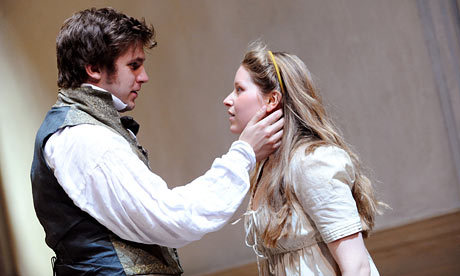
The storyline merges scientific debate with romantic philosophies to reflect the moral contest between classicism and romanticism. In the 1800’s, brilliant young Thomisina Coverley (Kristen Walker) grapples with both her academic lessons and entrance into womanhood while being instructed by her philosophical tutor Septimus Hodge (Brian Scanlan). Meanwhile, her mother, the vivacious Lady Croom (Paige Sommerer) is busy entertaining (in more ways than one) the famous guests who come to visit her estate.
In the present day, author Hannah Jarvis (Caitlin Reader) stays at the Croom estate to research a mysterious hermit who supposedly lived there at the same time as Lady Croom. While residing with the Coverley family, she encounters the cocky Bernard Nightingale (Steven Buehler), whose studies have also brought him to the Croom estate.
The mystery of the lives Lady Croom, her “special” guest, the unseen Lord Byron, and Septimus Hodge unfolds as the modern day characters piece together the events that happened at the estate more than a century before – unveiling surprising revelations about both the past and the present.
In a play where dialogue completely comprises the action, the main characters had no option but to rely solely on their acting skills to engage the audience. Luckily, the majority succeeded.
Walker was cast perfectly as Thomisina. Both inquisitive and innocent, Walker effectively bridged the gap between classicism and romanticism, which her character was scripted to do. It’s clear that Walker did her research, as she effectively communicates the difficult scientific principles Thomisina studies so that audience members can try to understand them as well as she does.
As Lady Croom, Sommerer was humorously flamboyant and extravagant in manner. Her crazy antics energized scenes that were progressing more slowly during the course of the show.
Both Reader and Buehler are astute and witty. Possessing much of the stage time, the actors make their modern day characters relatable to audience members to help connect the differing time periods.
The only casting weaknesses lie in minor characters, including the modern Chloe Coverley (Merill Arens) and the 1800’s era friend of Lady Croom’s brother Mr. Chater (Nathan Bryant). Arens is too soft-spoken as Chloe, and not expressive enough in her flirtatious emotions. Also, compared to his fellow actors, Bryant sounds more like a modern college student than an English poet since he is not articulate enough in his speech.
The true genius of “Arcadia” lies in the script, which includes more nuances and details than can be understood in the first viewing. The intricate nature of the plot makes it rewarding, as more can be appreciated and learned each time audiences see it performed.
The show is a wise reflection of human nature and the clash between logic and emotions. Director Kevin Brown successfully used this attribute to direct his actors to express internal conflicts through physical gestures, which helped make the dialogue-heavy show engaging.
Because of the intellectual nature of the show and the lengthiness, many audience members left during intermission. Apparently unable to handle the thoughtfulness of the show, these specific audience members exemplified a point that Stoppard makes through the show – those unwilling to pay attention to details will traverse through life making the same mistakes as those in the past.
The thirst for knowledge characterizes “Arcadia.” Though complex, the plot is innovative and enlightening, leaving audiences thinking about the deeper meanings of the show long after they leave the theater. Stoppard writes, “It’s wanting to know that makes us matter.” “Arcadia” ensures that audiences leave the theater knowing more about the nature of humanity than they did before.